Beyond the celebrations: Remembering the pioneers behind Notting Hill Carnival
From the activists who brought Caribbean communities together to the musicians, organisers and creatives who shaped its identity, the pioneers behind Notting Hill Carnival helped build one of Britain’s most significant cultural institutions. Their contributions, spanning generations and different areas of Carnival, are now being recognised in a permanent tribute at Westbourne Park.
More than a Carnival
Every August Bank Holiday weekend, the streets of west London come alive with colourful costumes, steelpan, calypso, soca and sound systems. For the 60th anniversary celebrations in August 2026, around two million people attended across the two-day event, according to the National Police Air Service (NPAS).
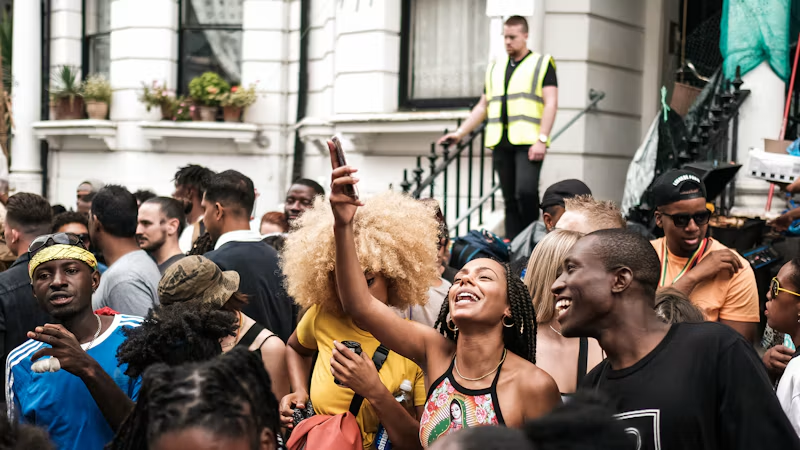
A group of people enjoying the lively atmosphere of Notting Hill Carnival. The photograph captures the collective celebration and energy of the annual Caribbean carnival in west London. Photograph: Glodie Miessi / Unspalsh.
For many, it is an annual celebration of Caribbean culture, music and community. But behind the festivities is a history shaped by generations of people whose creativity, determination and work helped establish one of Britain’s most recognisable cultural institutions.
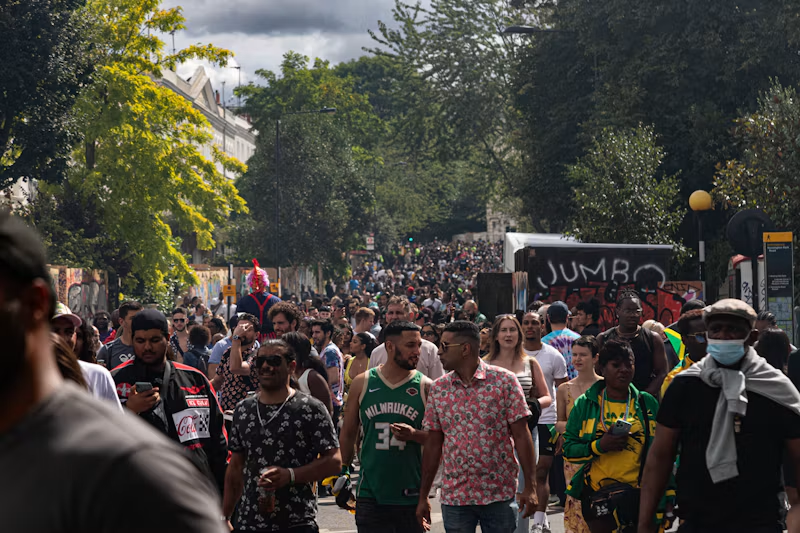
A busy street scene at Notting Hill Carnival, with groups of people enjoying the event and taking photographs. Photograph: Glodie Miessi / Unspalsh.
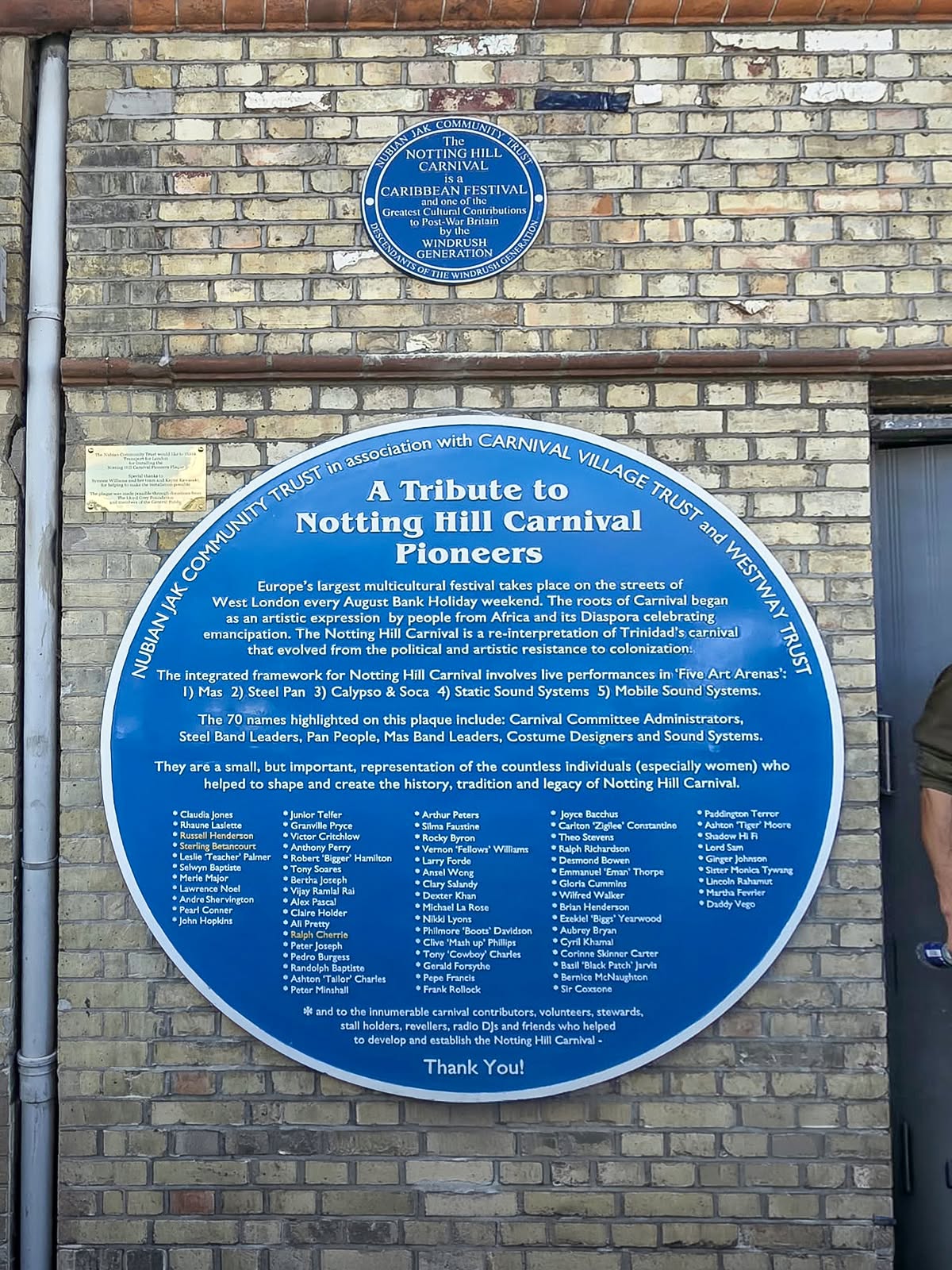
Those people are now recognised at Westbourne Park Underground station, where the plaque honouring the pioneers of Notting Hill Carnival was given a permanent home. TfL announced that it would be installed at the station on 28 August 2026, and the BBC reported that it was unveiled there ahead of Carnival weekend. A formal permanent installation event followed on 1 October, the first day of Black History Month. Soca News reported that the plaque was relocated from Notting Hill Adventure Playground, based at the Venture Centre on Wornington Road, to its new position outside the station. The plaque was created by the Nubian Jak Community Trust in association with Carnival Village Trust and Westway Trust, with TfL involved in the installation.
The Trust first unveiled the plaque in August 2018 and says it then stayed on public display at the Venture Centre on Wornington Road. Its inscription refers to 70 names. The Trust has since clarified that 69 are named individuals, while the 70th position represents the many thousands of people who have contributed to Carnival over the decades. The named individuals include Carnival administrators, steelband leaders, pan players, mas (masquerade) band leaders, costume designers and sound-system operators. The plaque also thanks the volunteers, stewards, stallholders, revellers, radio DJs and friends who helped build the event.
The setting is deliberate. London Transport began recruiting workers in the Caribbean in 1956, and TfL marked 70 years since that campaign alongside the Carnival’s 60th anniversary. Dr Jak Beula, the Trust’s chief executive, said in the installation announcement that the plaque:
“ensures their names, achievements and legacy will be remembered for generations to come.”
Understanding the tribute means looking beyond the names to the stories behind them.
The origins: From Claudia Jones to the streets of Notting Hill
During the 1950s, Notting Hill was home to a growing Caribbean population, but residents also faced racism, poor housing and racial hostility. The 1958 Notting Hill race riots and the murder of Antiguan carpenter Kelso Cochrane in 1959, which remains unsolved, exposed the tensions affecting Black communities in the area.
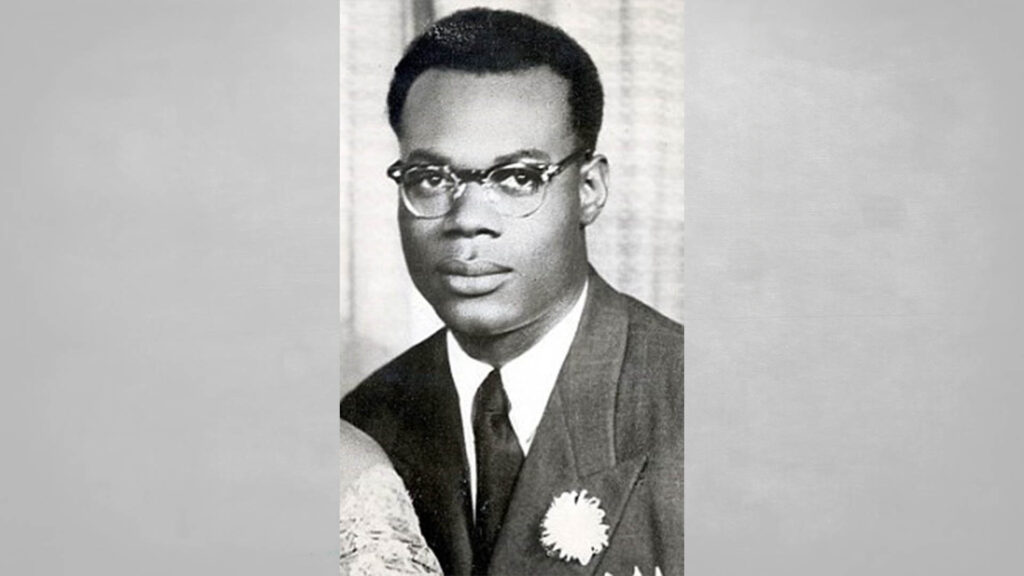
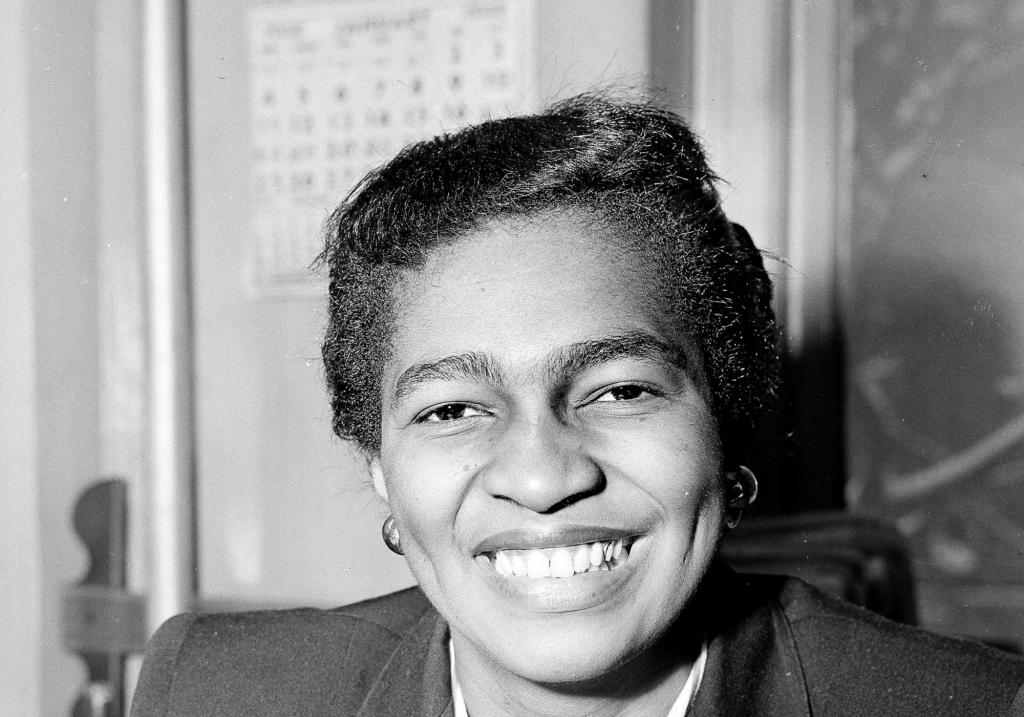
A photograph of Kelso Cochrane, the Antiguan-born carpenter who was murdered in Notting Hill in May 1959. His death, following a racist attack, intensified public concern about racial violence and discrimination in the area and forms an important part of the wider historical context surrounding the emergence of Notting Hill Carnival. Photograph: Kelso Cochrane / Fair Use.Claudia Jones, secretary of the Women’s Commission of the Communist Party, pictured in New York City on 22 January 1948. She later organised an indoor Caribbean Carnival in London in 1959, an important precursor to Notting Hill Carnival. Photograph: Anthony Camerano / Associated Press (public domain).
Against this backdrop, Trinidad-born journalist and activist Claudia Jones, founder of the West Indian Gazette, organised an indoor Caribbean Carnival at St Pancras Town Hall on 30 January 1959. The BBC broadcast the event, and the actor and singer Edric Connor, husband of Pearl Connor, directed it. The Trust describes it as a fundraiser for West Indians in Notting Hill who faced discrimination and violence. It continued annually until Jones’s death in 1964 and is widely recognised as a precursor to the celebrations that developed in west London.
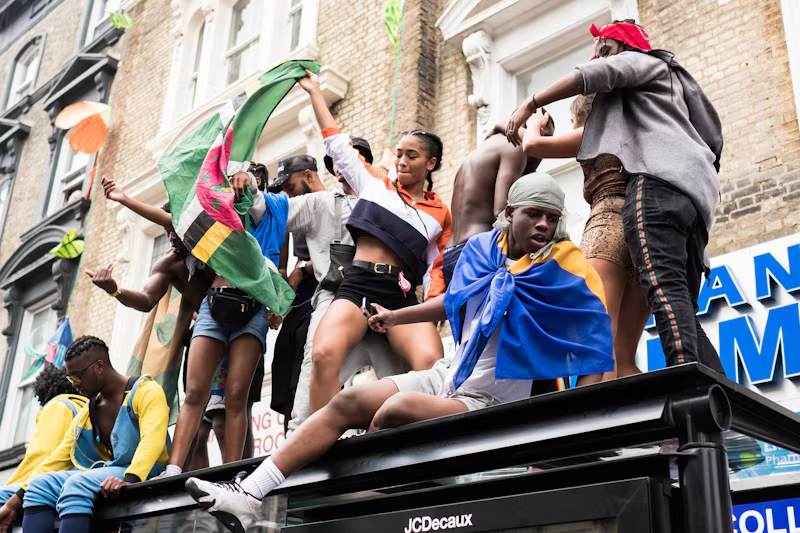
A group of people sit and stand on top of a bus stop as they take part in Notting Hill Carnival. Photograph: Glodie Miessi / Unsplash.
The street Carnival, however, had other beginnings. Rhaune Laslett, an English community activist and social worker, started a children’s carnival in Notting Hill, which the Trust dates to 1965. The Trust says the century-old Notting Hill Fayre was revived a year later with the support of the London Free School. Andre Shervington, who is also named on the plaque, is credited alongside Laslett with organising the 1966 street festival.
Trinidadian steelpan musician Russell Henderson played a central part. Invited to play, he took his band onto the streets, and people came out of their houses to follow. Sterling Betancourt and Ralph Cherrie played alongside him. The date is disputed. The Trust and the historian Kwaku place a spontaneous walk at a children’s event in 1965, with a planned procession in 1966. Other accounts date the first street festival and procession to 1966, and Carnival counts its 60th anniversary from that year. Henderson, Betancourt and Cherrie are the three names highlighted on the plaque.
The origins matter, and they are contested. Ansel Wong CBE, a former chair of the Carnival board and founder of the Elimu mas band, who is also named on the plaque, has said that Carnival has several origins, “all of them contested.” Jones helped establish a tradition of Caribbean carnival in Britain, Laslett’s community work gave the street festival its setting, and Caribbean musicians and communities shaped it into the event recognised today.
The people behind the culture
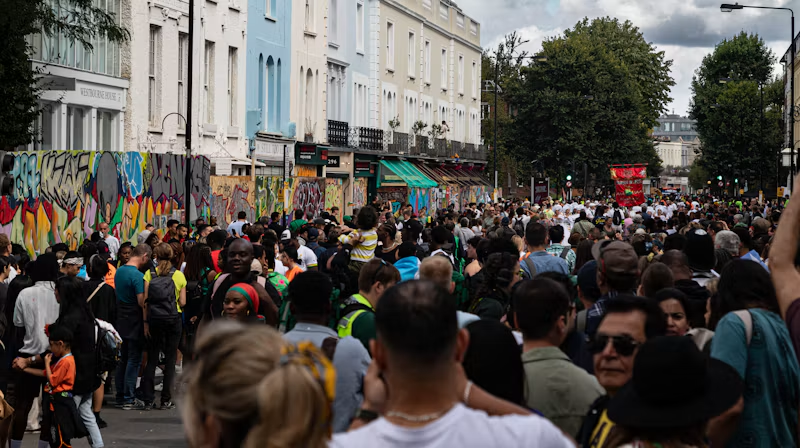
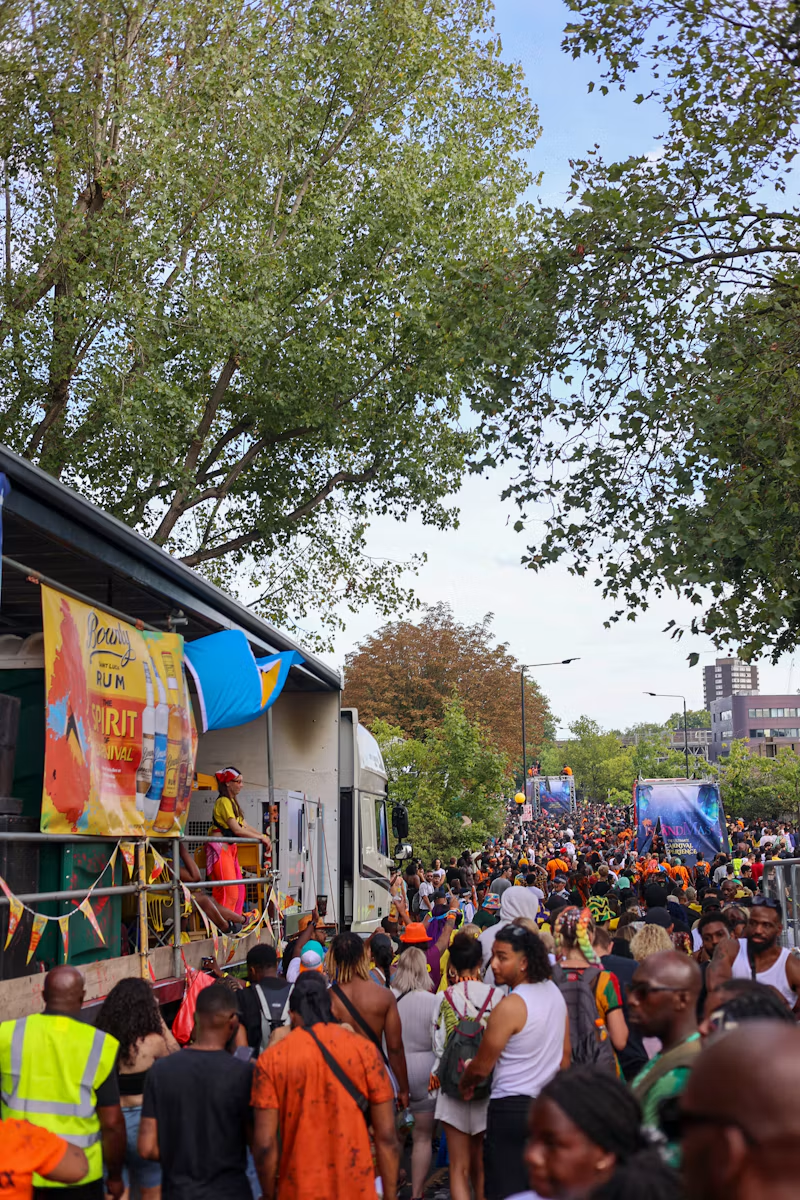
A large crowd gathers along the streets during Notting Hill Carnival, illustrating the scale of the annual event and its place in London’s cultural calendar. Photograph: Bernd Dittrich / Unsplash.
As Carnival developed, it became much more than a street procession. The plaque’s inscription describes five arenas of performance: mas, steelpan, calypso and soca, static sound systems and mobile sound systems. Behind each stood people with very different histories.
Leslie ‘Teacher’ Palmer became director of Carnival in 1973, and the Trust’s own plaque to him credits him with pioneering the template for the modern event. Wilfred Walker, a music promoter, ran live stages in the 1970s that gave early platforms to artists including Aswad and Eddie Grant. Claire Holder, from Trinidad, led Carnival as chairperson from 1989 to 1997, before becoming chief executive of the Notting Hill Carnival Trust in 1997. Bertha Joseph has been involved since 1976 as secretary and served for 24 years as a Brent councillor.
Pearl Connor, whose surname is spelt ‘Conner’ on the plaque, made her mark beyond the Carnival route. Born in Trinidad, she founded the Edric Connor Agency in 1956, helping Black actors, dancers, writers and musicians find work in British theatre, television and radio. With her husband she also promoted indoor carnival events in London halls in the 1960s.
Steelpan runs through the story. Sterling Betancourt, born in Laventille, Trinidad, in 1930, was among the Trinidad All Steel Percussion Orchestra players who came to Britain for the 1951 Festival of Britain. He stayed, founded Nostalgia Steelband and received an MBE in 2002. He died on 3 June 2026, aged 96. Selwyn Baptiste, also from Trinidad, formed what is described as Britain’s second steel band in 1967 and helped organise the early Carnival. Pepe Francis MBE and Randolph Baptiste were among the founders of Ebony Steelband in the late 1960s, and Baptiste later founded Stardust Mas and Pan Band in 1983. Gerald Forsythe OBE was the first tutor and maker of pans in Britain, according to London Remembers.
Masquerade and costume design are represented by Dexter Khan of Cocoyea, Clary Salandy of Mahogany and Ali Pretty of Kinetika. Khan says Cocoyea began in the early 1980s, when he and others were supporters of the Metronomes steel band. He met Peter Minshall, who went on to become one of the world’s top Carnival designers, and later worked with designers including Nikki Lyons, Arthur Peters and Wayne Berkley. Salandy grew up in Trinidad, moved to London at 15 to study theatre design and founded Mahogany in 1989 with Michael Ramdeen. Pretty founded Kinetika in 1997 and designed three winning bands in 1998, 1999 and 2004. Larry Forde of Sukuya and Gloria Cummins of Elimu merged their bands to form Flamboyan in 1985. Vernon ‘Fellows’ Williams, named in one Carnival account among the players who accompanied Henderson, co-founded the Genesis mas band with his wife Allyson in 1980. Silma Faustine, from Dominica, led a band of masqueraders in the early street years, and Lincoln Rahamut brought a new standard of mas after arriving from Trinidad in 1970.
Sound systems carried the Jamaican contribution. Daddy Vego, known to the Trust as Barrington Von Adams, arrived from Jamaica in 1956 and was the first Jamaican to set up a static sound system on All Saints Road, according to a claim attributed to The Voice in the Carnival 60 Magazine. In 1988 he opened the People’s Sound record shop at 11 All Saints Road. Lloyd Blackford, known professionally as Lloyd Coxsone and by the sound-system name Sir Coxsone, was born in Jamaica and settled in south-west London in 1962. Lord Sam formed the London Brotherhood of Soca Sounds in 1980, the first soca sound system at Carnival, and helped make sound systems mobile. Basil ‘Black Patch’ Jarvis and Shadow Hi Fi stand among the other names. Michael La Rose co-founded the People’s War Carnival Band with his brother Keith and helped form the Association for a People’s Carnival.
The names do not all share one story. Some pioneers are widely documented, while for others the published record is thin. The inscription itself says the names are a small representation of countless others, especially women. Their inclusion matters in its own right.
The names on the plaque
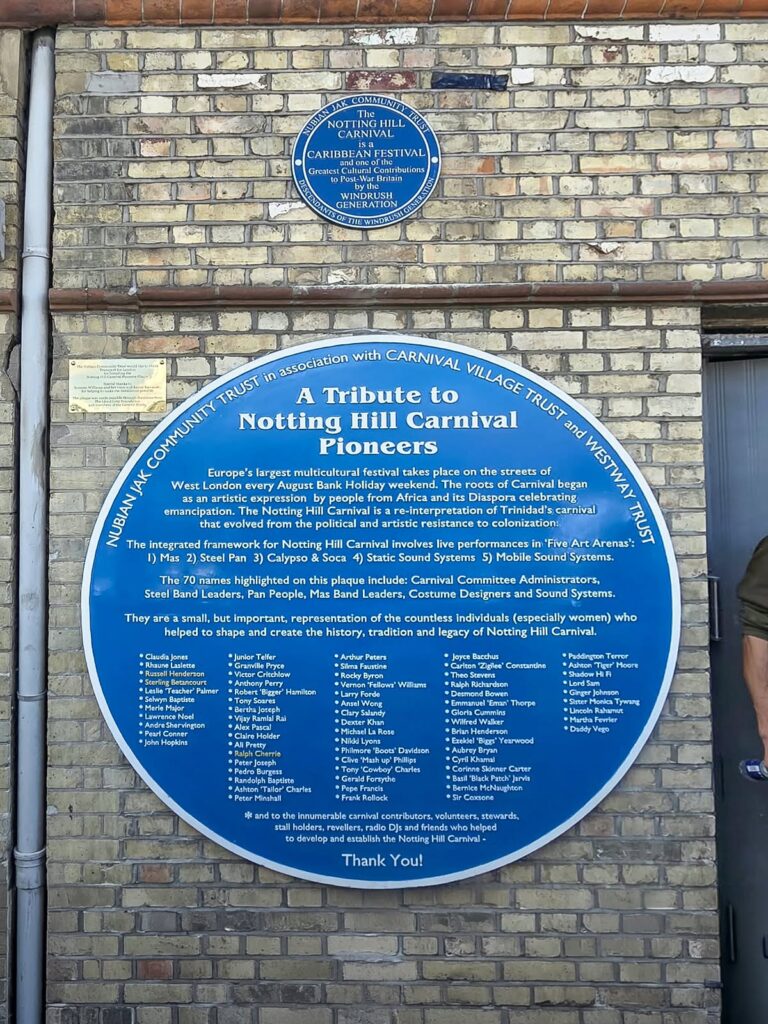
A photograph showing the large Notting Hill Carnival pioneers plaque alongside the smaller commemorative plaque at Westbourne Park. The permanent tribute recognises the individuals and wider community whose contributions helped shape Notting Hill Carnival. Photograph courtesy of the Trinidad and Tobago High Commission and Nubian Jak Community Trust.
As transcribed from the plaque: Claudia Jones, Rhaune Laslett, Russell Henderson, Sterling Betancourt, Leslie ‘Teacher’ Palmer, Selwyn Baptiste, Merle Major, Lawrence Noel, Andre Shervington, Pearl Conner, John Hopkins, Junior Telfer, Arthur Peters, Granville Pryce, Victor Critchlow, Silma Faustine, Rocky Byron, Anthony Perry, Vernon ‘Fellows’ Williams, Robert ‘Bigger’ Hamilton, Larry Forde, Tony Soares, Ansel Wong, Bertha Joseph, Clary Salandy, Vijay Ramlal Rai, Dexter Khan, Alex Pascal, Michael La Rose, Claire Holder, Nikki Lyons, Ali Pretty, Ralph Cherrie, Philmore ‘Boots’ Davidson, Peter Joseph, Clive ‘Mash Up’ Phillips, Pedro Burgess, Tony ‘Cowboy’ Charles, Randolph Baptiste, Gerald Forsythe, Ashton ‘Tailor’ Charles, Pepe Francis, Peter Minshall, Frank Rollock, Joyce Bacchus, Carlton ‘Zigilee’ Constantine, Theo Stevens, Ralph Richardson, Desmond Bowen, Emmanuel ‘Eman’ Thorpe, Gloria Cummins, Wilfred Walker, Brian Henderson, Ezekiel ‘Biggs’ Yearwood, Aubrey Bryan, Cyril Khamal, Corinne Skinner Carter, Basil ‘Black Patch’ Jarvis, Bernice McNaughton, Sir Coxsone, Paddington Terror, Ashton ‘Tiger’ Moore, Shadow Hi Fi, Lord Sam, Ginger Johnson, Sister Monica Tywang, Lincoln Rahamut, Martha Fevrier and Daddy Vego.
A plaque, a debate and a question of representation
Large crowds gather along the streets during Notting Hill Carnival, reflecting the scale of the annual event. Photograph: Bernd Dittrich / Unsplash.
While the installation is a moment of recognition, the plaque has also prompted discussion about how the history of Notting Hill Carnival is told.
The inscription says the roots of Carnival lay in artistic expression by people from Africa and its diaspora celebrating emancipation. It describes Notting Hill Carnival as a reinterpretation of Trinidad’s carnival that grew out of political and artistic resistance to colonisation.
In a statement dated 11 September 2026, the Nubian Jak Community Trust said it had received comments and enquiries about the wording. It said there was a misconception that the plaque claims Carnival was founded by people who came directly to Britain from Africa, and that it makes no such claim. The Trust explained that the reference to Africa and its diaspora concerns the wider global history of Carnival, including traditions in Trinidad and Tobago, Brazil and New Orleans. It said the plaque identifies Trinidad as the principal Caribbean influence on Carnival in Britain.
The Trust also accepted that some of the wording on the wider origins “could have been expressed more clearly.” It said its intention was always to recognise the predominantly Caribbean pioneers who established Carnival in Britain, particularly those from Trinidad and Tobago. Its installation announcement describes the honourees as Caribbean men and women and Windrush Generation heroes.
A smaller plaque carries a separate inscription describing Carnival as a Caribbean festival and one of the greatest cultural contributions to post-war Britain by the Windrush generation. The additional wording places Caribbean identity and the Windrush generation more explicitly at the centre of the public recognition.
The debate raises wider questions about who tells the history of cultural institutions, how different contributions are represented and why getting that history right matters.
Preserving the legacy for future generations
The plaque’s position at Westbourne Park puts the recognition close to the start of the Carnival route, where residents, commuters and visitors will see it. Dexter Khan of Cocoyea welcomed the move, according to Soca News, saying:
“Westbourne Park is the ideal location for the plaque.”
People gather along the route as colourful floats make their way through Notting Hill Carnival, showcasing the event’s music, pageantry and street celebrations. Photograph: Tiyapo Moseki / Unsplash.
But preserving Carnival’s legacy involves more than displaying names on a wall. In comments published by ITV News London on 25 August, Notting Hill Carnival chief executive Matthew Phillip said Carnival did not begin as a spectacle: “It was to bring the divided together!” He added that the 60th anniversary belongs to the people who built it.
A woman stands on top of a sound system while a crowd gathers around her during Notting Hill Carnival, capturing the importance of sound systems to the event’s street celebrations. Photograph: Tiyapo Moseki / Unsplash.
That work is already under way. Carnival 60, produced by Notting Hill Walks and More Curricular CIC, ran from May to October as a six-month programme of walks, talks and exhibitions. Archives hold primary material, including the George Padmore Institute’s Carnival collection, which draws on the papers of Michael La Rose and the People’s War Carnival Band. Online, the Notting Hill Carnival’s Google Arts & Culture pages include a feature on the women behind Carnival and Dexter Khan’s own account. The National Archives and the London Museum both offer teaching resources on its origins. Several of the people named have died, among them Henderson in 2015 and, this June, Betancourt. Recording and teaching their stories is urgent.
The people behind the celebration
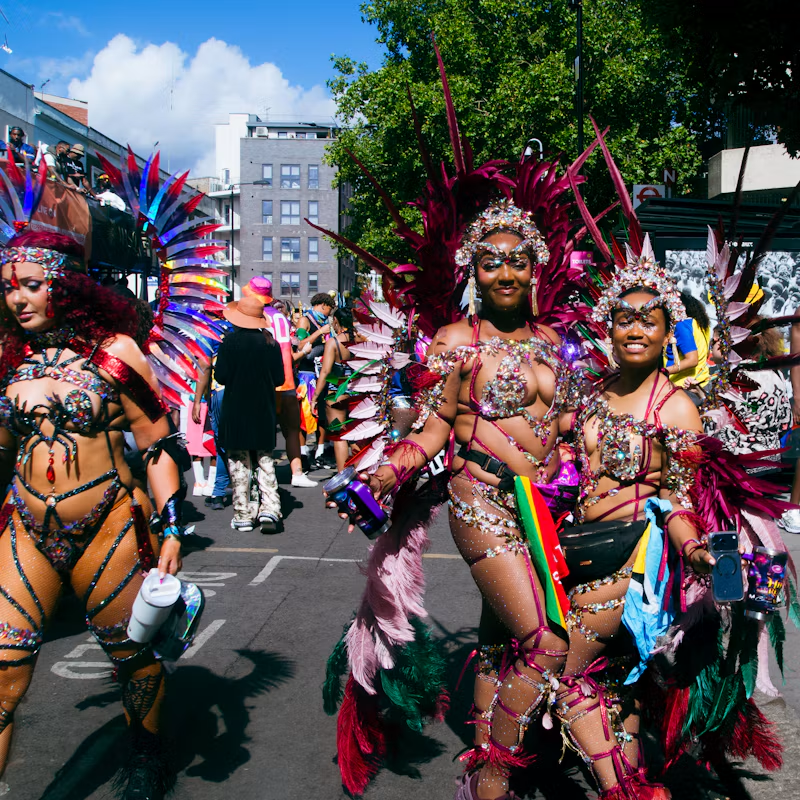
Women dressed in Carnival costumes take part in Notting Hill Carnival, showcasing the creativity, colour and cultural expression that are central to the annual event. Photograph: Kevin Musumbu / Unsplash.
From Claudia Jones’s indoor Carnival to the procession led by steelpan musicians, and from the growth of mas bands to the sound systems of All Saints Road, Notting Hill Carnival has been shaped by generations of people. TfL confirms that Claudia Jones and Rhaune Laslett are the first two names on the plaque.
The plaque at Westbourne Park gives 69 individuals a permanent place in the public record, while its collective 70th position acknowledges the thousands of others whose work helped make the event possible. Their names are now on the wall. Their stories deserve to be told wherever Carnival is celebrated.