
More than 10,600 West Surrey households are projected to receive less Council Tax Reduction under a proposed scheme, while East Surrey is proposing support of up to 100% of eligible Council Tax. Residents have until 3 December to have their say.
Of the 12,174 households included in West Surrey’s modelling, 10,683 are projected to receive less Council Tax Reduction under the draft scheme, while 1,349 could receive more. A further 142 households are projected to see little change, according to the consultation documents.
The proposals form part of separate consultations launched on 7 October to shape the Council Tax Reduction Schemes planned for East Surrey and West Surrey from April 2027.
Council Tax Reduction (CTR) helps eligible people on low incomes pay their Council Tax bills. The consultations cover working-age claimants only. Support for people who have reached State Pension age is governed by national rules and is not being changed through these proposals.
Neither scheme has been agreed. Residents are being asked to share their views before final decisions are made. Existing support will remain in place while the consultations take place.
What is West Surrey proposing?
The draft West Surrey scheme would cap Council Tax Reduction at 85% of eligible Council Tax. Working-age households receiving support would therefore have to pay at least 15% of their eligible bill themselves.
Support would also be calculated using no more than the Council Tax charge for a Band D property. Households in bands E to H would have to pay the full difference between the Band D charge and their actual charge, as well as their minimum contribution towards the Band D amount. Other deductions could increase the amount they owe.
The proposals include a £6,000 limit on savings and other capital, excluding the home someone lives in. Working-age households with capital above that limit would not qualify under the draft scheme.
Other proposed changes include:
- A 20% taper: support would reduce by 20p for every £1 of assessed income above the household’s applicable amount, calculated using its circumstances and relevant allowances.
- A £10 weekly deduction for other adults: a deduction would apply for each non-dependant living in the property, such as an adult son or daughter.
- A Minimum Income Floor for self-employed claimants: after a proposed 12-month start-up period, a claimant whose earnings fall below the relevant threshold could normally be assessed as earning the equivalent of 35 hours a week at the applicable National Minimum Wage rate. The draft rules would allow for exemptions and adjustments.
- A Universal Credit change buffer: intended to reduce repeated small or late recalculations when a claimant’s Universal Credit changes.
- Up to three months’ backdating: claims could be backdated where the qualifying conditions are met.
The draft scheme is modelled to reduce annual spending on working-age Council Tax Reduction from around £19.44 million to £16.3 million in 2027/28, a projected reduction of approximately £3.13 million. These are estimates, and the final cost could change as the scheme is developed.
The consultation documents project that 87.8% of households included in the modelling would receive less support, while 11.1% would receive more. The remaining 1.2% are projected to see little change. These figures are estimates based on the draft scheme, not final decisions on individual households’ support. Percentages may not total 100% due to rounding.
West Surrey Shadow Councillor Leslie Rice, Portfolio Holder for Finance, said:
“As we move towards the new West Surrey Council, we need to bring together the different Council Tax Reduction schemes currently operated by the district and borough councils to support residents. We want to hear from people who currently receive Council Tax Reduction, and those who support them, so that their experiences and views can be considered before the final scheme is agreed. The aim is to ensure the new scheme is fair, sustainable and meets the needs of residents across West Surrey.”
How does the East Surrey proposal differ?
East Surrey’s draft scheme proposes support of up to 100% of eligible Council Tax, with properties in all Council Tax bands able to qualify.
Working-age households with more than £16,000 in savings or other capital, excluding the home they live in, would not qualify under the draft scheme.
The proposed scheme would use a means test with a 20% taper. Support would reduce by 20p for every £1 of assessed income above the household’s applicable amount, calculated using its circumstances and relevant allowances.
The draft also proposes a standard £10 weekly deduction for each non-dependant living in the property and a minimum Council Tax Reduction award of £5 a week.
For self-employed claimants, a proposed Minimum Income Floor could mean earnings are assessed at the equivalent of 35 hours a week at the applicable National Minimum Wage rate after a 12-month start-up period, subject to the draft rules.
Claims could be backdated by up to three months where the qualifying conditions are met. The proposal also includes alignment with new Universal Credit claims where appropriate, alongside time-limited transitional protection for certain existing claimants who would otherwise face a significant reduction in support when moving to the new scheme.
Surrey County Council’s press office confirmed that the details of the transitional protection have not yet been finalised.
East Surrey Shadow Councillor Andy Burton, Portfolio Holder for Finance and Resources, said:
“Council Tax Reduction is an important source of financial support for eligible residents, and I would strongly encourage anyone affected to take part in the consultation. No final decisions have been made, and existing support will remain in place while the consultation takes place. Your views will help decision-makers understand the potential impact of the proposals before the final scheme is agreed.”
How could the proposals affect residents?
The consultation documents include financial modelling and draft equality impact assessments providing further information on the potential effects of the proposed schemes on households.
In response to questions about the potential implications for Council Tax collection, arrears and financial hardship, Surrey County Council’s press office said these would be considered alongside consultation responses and further analysis.
The press office reiterated that the proposals remain at consultation stage and that no final decisions have been made.
Why are the schemes being reviewed?
From 1 April 2027, Surrey County Council and the county’s 11 district and borough councils are due to be replaced by two new unitary authorities: East Surrey Council and West Surrey Council.
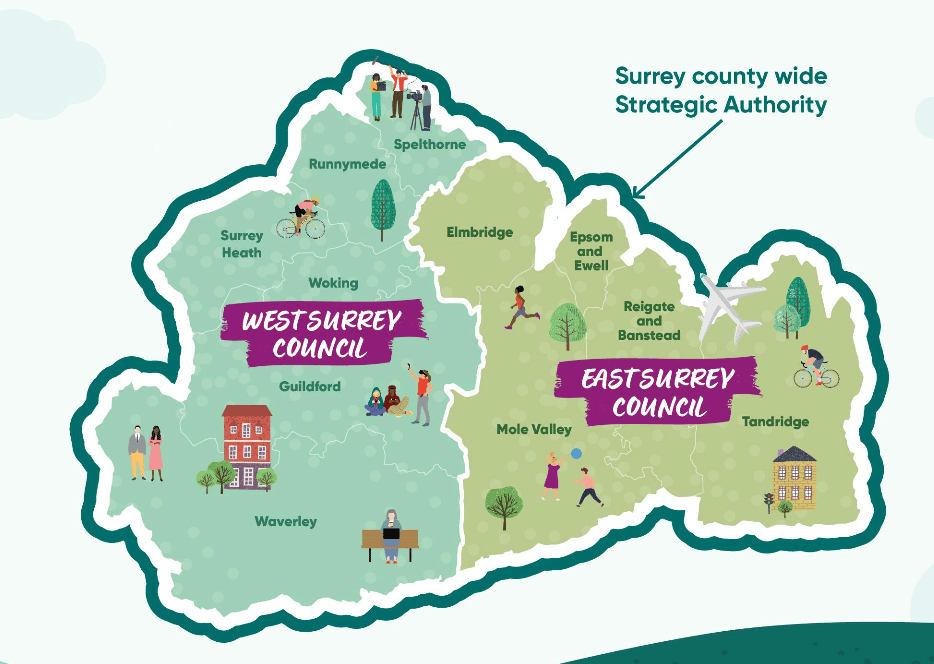
Runnymede will become part of West Surrey, alongside Guildford, Spelthorne, Surrey Heath, Waverley and Woking. East Surrey will cover Elmbridge, Epsom and Ewell, Mole Valley, Reigate and Banstead, and Tandridge.
Each district and borough council currently operates its own Council Tax Reduction Scheme. Eligibility criteria and assessment methods can differ depending on where a resident lives.
The two new councils will each need a single working-age scheme covering their respective areas. The draft proposals were developed following a review of existing arrangements across Surrey.
Both councils say consultation responses will be considered alongside financial modelling, equality impact assessments, operational evidence and other relevant information before the final schemes are agreed.
How to have your say
Residents can read the proposals and complete the relevant online questionnaire before the consultations close on 3 December 2026.
- East Surrey: Read the proposals and complete the consultation.
- West Surrey: Read the proposals and complete the consultation.
For questions about the East Surrey consultation, residents can call 01372 474474 or email [email protected].
For the West Surrey consultation, residents can call 01276 707100 or email [email protected].
Existing councils will continue delivering services as normal during the transition. The new Council Tax Reduction Schemes are intended to take effect from 1 April 2027.