
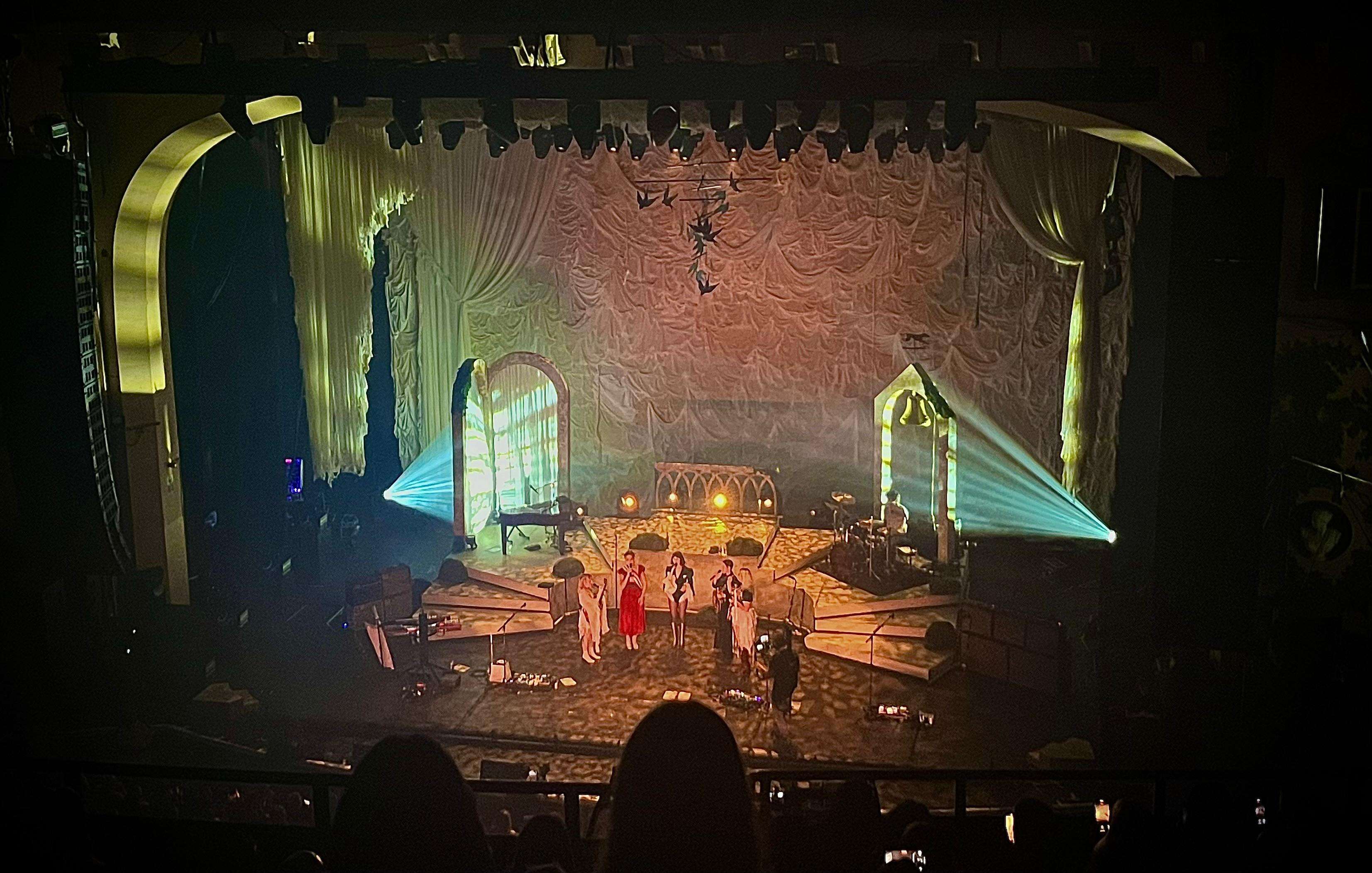
From the release of ‘Nothing Matters’ to their new album ‘From the Pyre’, The Last Dinner Party has become a direct manifestation of baroque rock, embodying the beauty and sadness that encapsulates loss, love, death, and every moment in between across 2 albums. The release of their new album has brought even more storytelling and melodic creativity to the stage than their last release so let’s review some objective, meaning my, favourites and the incredible performance that they put on at O2 Academy Brixton on their last night touring the UK & Ireland.
The first track, ‘Agnus Dei’, translates to ‘Lamb of God’, signifying a prophet acting as a sacrificial lamb for the sins of the world. Through the ascending power of the instruments and the pleas of the lyrics, the song addresses power, sacrifice, identity and the spectacle of performance. The use of apocalyptic imagery, not only expecting the end of the relationship (“/apocalypse”) but craving the anticipation as if the ending was inevitable, aligning the end of a relationship (possibly with their audience) with the collapse of the world. Attempting to bargain a conventional relationship for fame or “name in lights forever” to become a myth; a legacy, yet admitting this negotiation may come from a place of insecurity and need for others in an endeavour to escape the ordinary. When I attended the night 2 show in Brixton, I was immediately blown away by the power this song holds. I knew that this would be their opening song but did not realise the immediate triumph which left my defences crumbling as I cheered louder than ever before, knowing this would be a flawless concert.
Second best: the long-awaited fan-favourite release that has been played at gigs for 2 years now did not disappoint. An untamed anthem for those who have ever felt ‘Second Best’, the song begins playfully, toying with their own self-pity and pleading for recommitment while trying to protect their own feelings. The realisation later dawns that they are “wasting [their] time” as a moment of clarity and recognition for their own self-worth occurs, but a fleeting insecurity still lurks as they are uncertain that they could ever be someone’s first place. This is interrupted by the crushing reality that they are worth more as the muted, yet strained chorus (powerfully delivered by Lizzie Mayland) overwhelms this self-doubt, culminating in a visceral scream (harmfully conveyed from Emily Roberts) that I could only hope to recreate, rather irritatingly, while standing in the stalls. This song beautifully encapsulates the bitterness felt by many who have ever felt inferior, allowing you to taunt your former: Ain’t it good? Second best. When played on stage, the crowd erupted as a wave of recognition washed over them. The reaction displayed the fact that this song was and always will be for the fans.
The Scythe… It’s tricky to listen to the comforting yet melancholic medley that Abigail Morris unintentionally wrote to reckon with her grief without welling up. From the first moment the guitar, using an Ebow, is played, I shiver at the cords as the familiarity of love and loss washes over me – the pain we have all felt at some point, and the strange comfort in knowing that loss is part of being human. We may fear the inevitable, but when the time comes, the connection doesn’t disappear as our bonds outlast loss. Wrestling with the acceptance, vulnerability and pain that comes with grief, this track is a blend of cinematic expression and powerful rock vitality, accentuated by Roberts’ guitar solo, ushering the song towards its emotional peak. To introduce this song Morris stated this song was for us, encouraging the crowd to belt out the lyrics. In truth, this was a struggle as the emotions caught in my throat, but the band’s performance became utterly soulful and poignant.
How could we talk about The Last Dinner Party’s second album without mentioning its first single, “This Is the Killer Speaking”? Born from the treacherous act of ghosting a singer-songwriter from a band, the fabled track turns modern dating practices into a Western-inspired narrative driven by towering vocals and relentless instrumentation. By the end, the song collapses into illustrious disorder, each instrument battling for dominance in a gratifying harmony, acting as a reminder that even abandonment can ignite something spectacular. Seeing this performed live and dancing, rather clumsily, with other fans, members of the band, and their opening act (Imogen and the Knife) was something else entirely; an overwhelming force as the chaos onstage spilled straight into the crowd, and I found myself caught up in the shared energy.
Many other songs performed stood out to me: ‘On Your Side’, a tender, yet soaring track about loyalty and commitment in a complex and tumultuous relationship, ‘Caesar on a TV screen’, an anarchic track on the fragility of ambition, ‘Mirror’, an exploration of how we are a reflection of other people’s perceptions, and ‘Big Dog’, an unreleased song that’s only been performed live acting as a defiant anthem to those who underestimate you. However, a new song was debuted, seeming to question whether self-erasure in the name of love is worth it and coming to the realisation it isn’t, but I’ll allow the band to decide when everyone is ready to hear more.
I would also like to take a moment to highlight the incredible performance from their opening act, Imogen and the Knife. Their set was not only an impressive ‘prelude’ to the night but also showcased a remarkable level of artistry and energy that deserves recognition, though their album is rich and nuanced enough to merit a full review of its own, which I hope to explore separately.
Ultimately, what The Last Dinner Party achieved at O2 Academy Brixton was not just a setlist, but a shared reckoning. Across both albums, their music wrestles with devotion and destruction, grief and grandeur, and seeing these songs performed live felt like stepping inside that world rather than simply observing it. The band has only refined their baroque rock identity by seamlessly blending theatrical imagery with the hope and pain we can feel as human. With the exploration of darker, more mythological and character-driven narratives, they invite you to sit with discomfort and romanticise collapse, exposing the messiness of devotion, grief and ambition without offering easy resolutions. In this sense, The Last Dinner Party has only proved that their presence on the stage is not only well deserved but significantly important for the inspiration of art.
Written and photography by Jaz Siddle