
By: Debra Oh
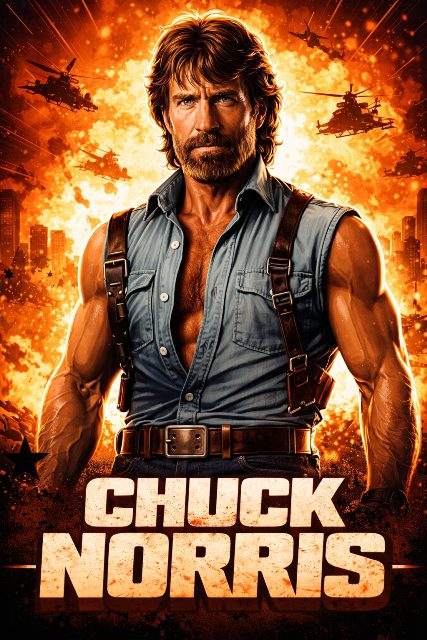
Few figures have occupied as many corners of popular culture as Chuck Norris, whose presence bridged action cinema, television, and internet culture. The recent news of the legendary 86-year-old’s death brings to a close a career defined by both longevity and reinvention.
Norris was recently hospitalized in Hawaii for a medical emergency, though the exact cause of his death has not been publicly confirmed. His family described his passing as sudden and requested privacy during this time, emphasizing how he was surrounded by loved ones when hospitalized and was at peace.
Norris first rose to prominence not through Hollywood but through discipline and sport. After serving in the United States Air Force, he began training in martial arts while stationed in Korea, eventually becoming a champion in multiple disciplines. His transition into film came in the early 1970s, most notably alongside Bruce Lee in The Way of the Dragon, a role that introduced him to global audiences and showcased his authentic combat skills.
Throughout the 1980s and 1990s, Norris became a staple of the action genre, starring in films such as Missing in Action and Delta Force. His performances were defined by physical authenticity, a quality that distinguished him from many contemporaries and made his fight scenes both compelling and credible.
His influence extended into television, where he became a household name with Walker, Texas Ranger. Running for nine seasons and spanning 196 episodes, the series portrayed a character who combined moral authority with martial prowess, cementing Norris’s role in popular culture.
Even as he reduced his acting workload in later years, Norris remained relevant through internet memes that humorously amplified his legendary persona. He embraced this shift, demonstrating a willingness to evolve with changing media landscapes and new audiences.
Tributes following his death have highlighted his personal qualities as much as his professional achievements. Family members described him as deeply attentive and compassionate, with his granddaughter noting that he “would make it known that he was listening to you and only you” in any room. His daughter praised him as a protector and a source of constant love.
Norris’s impact also extended into political and cultural circles, where he maintained friendships with high-profile figures including George H. W. Bush, Arnold Schwarzenegger, and Benjamin Netanyahu. Tributes from colleagues and public figures emphasised both his professional achievements and his warmth and loyalty as a person.
Fellow actors and martial artists also celebrated his influence. Dolph Lundgren described him as a role model whose “respect, humility, and strength” set a standard within the industry. Others echoed similar sentiments, highlighting the balance he maintained between discipline and character.
His influence wasn’t limited to action fans or martial artists. Even renowned horror author Stephen King admitted that Norris’ 1982 film Silent Rage, in which he played a sheriff trying to stop a maniacal killer, “scared hell out of my boys…and me.” King also playfully shared some of his favourite Chuck Norris jokes, writing: “My fave Chuck Norris joke: Chuck doesn’t flush the toilet, he scares the s*** out of it.” These anecdotes are a testament to the actor’s larger-than-life persona and enduring presence in popular culture.
His family, announcing his passing, reflected on a life lived with “faith, purpose, and an unwavering commitment to the people he loved.”
From martial arts champion to action star, TV icon, and internet legend, Chuck Norris leaves behind a legacy of skill, resilience, and authenticity that will continue to inspire fans, fellow performers, and storytellers around the world.
Written by: Debra Oh, Edited by: Paige Tamasi, Photography by: AI-Generated photo by Debra Oh, Published by: Debra Oh